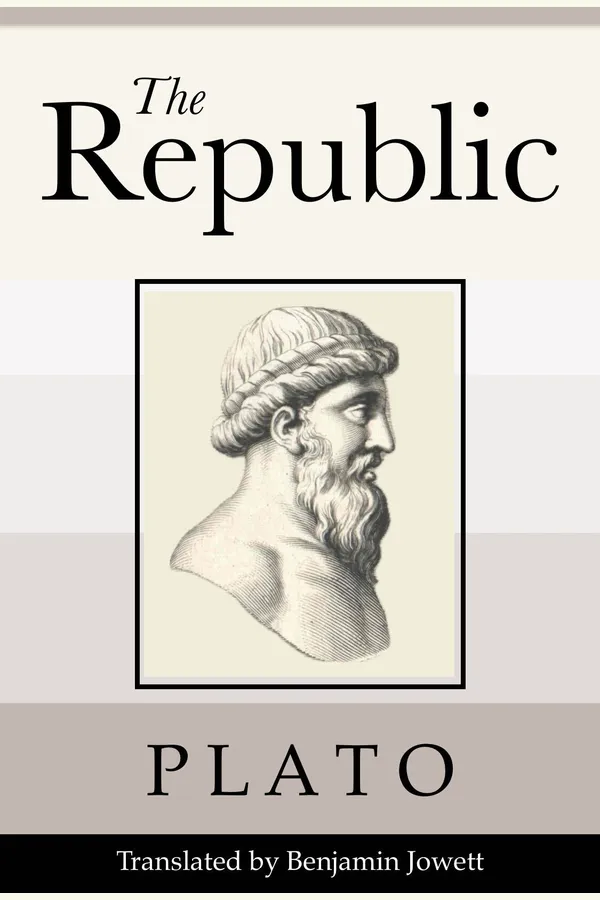
Cover: Cover of the Project Gutenberg edition (eBook #1497) · Public domain · source
The Republic
Plato · c. 428 BCE–c. 348 BCE
What is justice, and is the just person happier than the unjust? To answer, Socrates builds a city in words — and along the way gives us the philosopher-ruler, the allegory of the cave and the divided line, on which noesis, the understanding that gives this society its name, stands highest of all ways of knowing.
- First published
- c. 375 BCE
- Difficulty
- Demanding
- Reading time
- About 8½ hours
- Translation
- Benjamin Jowett
Reading time: 118,930 words in Project Gutenberg text #1497, the dialogue only (Jowett's introduction excluded), read at 238 words per minute.
Jowett's translation first appeared in The Dialogues of Plato (1871).
- justice
- the soul
- the cave
- the divided line
- education
Where to read it
- Read free — Standard EbooksPublic domain text, carefully proofread and produced. · checked 11 Oct 2026(opens in a new tab)
- Read free — Project GutenbergPublic domain in the USA; check your local law outside it. · checked 11 Oct 2026(opens in a new tab)
- Read free — WikisourcePublic domain transcription. · checked 11 Oct 2026(opens in a new tab)
Copyright
- Kenya
- Public domain (translator d. 1893)
- United States
- Public domain
NOESIS hosts no book files. Links lead to the sources named.
Questions for discussion
Retell the allegory of the cave in a Nairobi setting. Who is in the cave today, and what are the shadows?
On the divided line, what separates noesis from opinion? Where does most of what you 'know' sit?
Is Plato's ideal city a utopia or a warning?
Thrasymachus says justice is the advantage of the stronger. Has Socrates really answered him?
Member reviews
No member has reviewed this book yet. Reviews come only from members, and a moderator reads each one before it appears.